
Digital natives were either exposed to modern technology and social media at a developmental age or grew up with it their whole lives. As a digital native, I encounter astrology on social media daily. The medium in which I consume astrology content is often artificial and hedonistic: stroking the ego, providing general and broad assumptions on character, or associating entirely irrelevant facts with your zodiac sign. The abundance of posts influenced my self-esteem and perception of myself, encouraging comparison of myself to others associated with more desirable traits.
Though not yet proven to be scientifically based, astrology may have psychological applications as a coping mechanism for the overstimulated and overstressed minds of Generation Z and Millennials.
Astrology remains the target of academics, skeptics, and astrologists inquiring as to the scientific validity and applicability of astrology in people's daily lives. Although many astrologists attempted to prove the scientific validity of astrology, it is still regarded as a "pseudoscience." Common arguments of astrology skeptics include: astrology is founded in magic and superstition, there is no scientific basis for astrology, and why are zodiac signs determined at birth and not conception? (Dean 166). In layman's terms, astrology is a pseudoscience studying the planets and Zodiac and its correlation to personality and identity.
Some notable astrologists include Michel Gauquelin, Dane Rudhyar, Geoffrey Dean, and Arthur Mather. Gauquelin, Dean, Rudhyar, and Mather are all astrologists with published work from the 1970s to 1990s. Dean and Mather focused more on damning evidence astrology is accurate and would often publish biased work. Gauquelin objectively looked at the data and research and was often critical of astrology though being an astrologer. Rudhyar connected the psyche to astrology and often wrote more about the psychological influences of astrology instead of its scientific validity regarding the planets. However, the consumption of astrology has changed today.
Astrology, in its watered-down state, can manipulate how people perceive themselves and others through their zodiac signs. Although astrology today is not entirely representative of its predecessor, it still has influence and intrigue among astrologists and others. The primary consumers of 21st-century astrology are Millennials (born 1981 to 1996) and Gen Z (born 1997 to 2010).
Where did astrology originate?
Astrology originated as a tool for early civilizations to navigate the land and tell time with the lunar phases. Archeologists and scientists first discovered evidence of astrology through cave paintings from 30,000 – 10,000 B.C. ("How it Began"). From 300 B. C. to the 5th Century A.D., the Greeks made significant advances in astrology and named the planets and zodiac signs figures from Greek mythology and literature. An astrology work, Tetrabiblos, published by Ptolemy, contained information about planets, zodiac signs, houses, and aspects astrologists still use today ("How it Began").
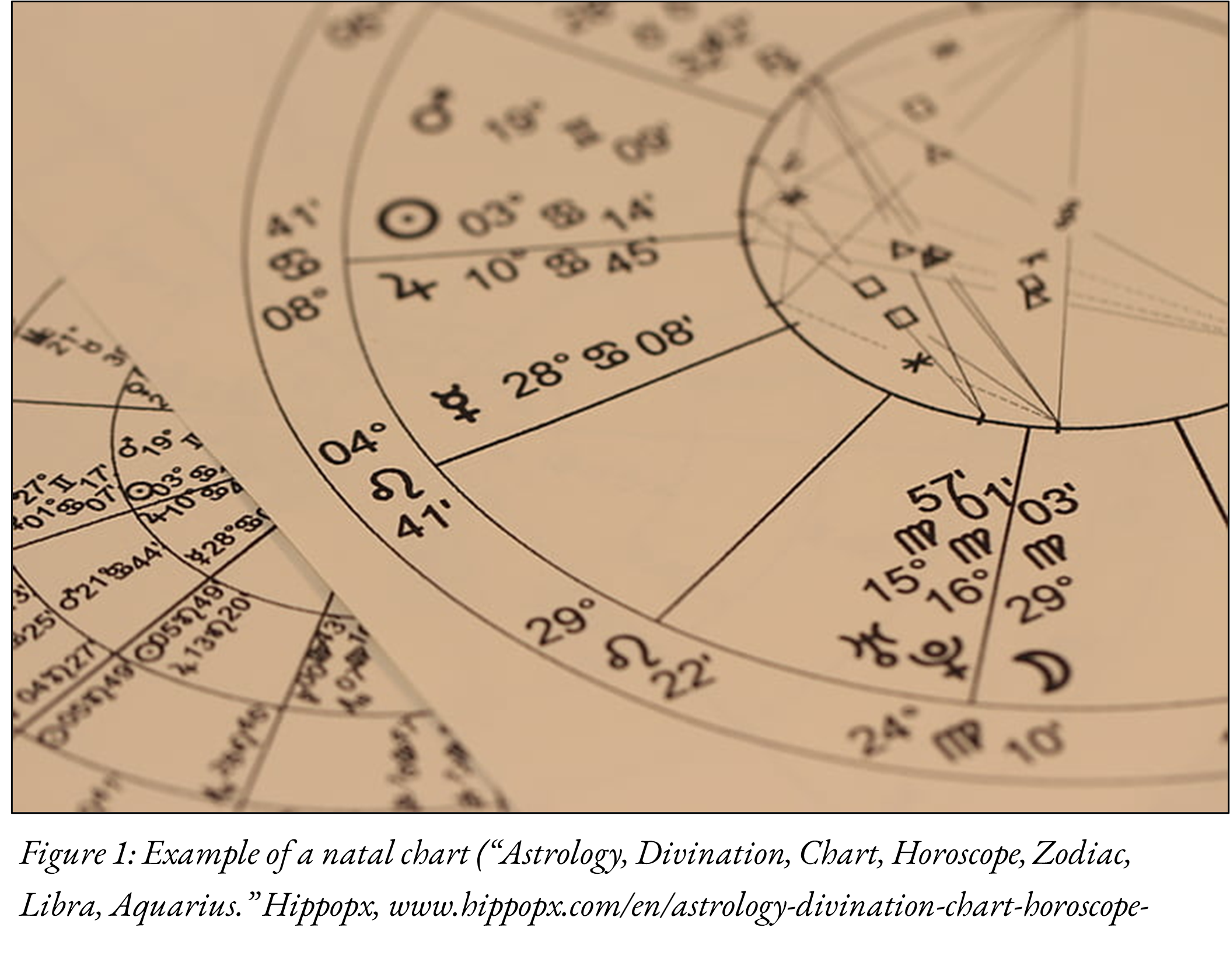
The 12 zodiac signs, constellations determined by their date and relationship between the sun and the sky, include Ares, Taurus, Gemini, Cancer, Leo, Virgo, Libra, Scorpio, Sagittarius, Capricorn, Aquarius, and Pisces. Astrologists determine personality and other patterns through one's natal chart. A natal chart consists of twelve houses that define the aspects of life that the main zodiac sign (sun sign) does not include. Some houses have the house of self, the house of family and home, the house of communication, etc. Astrologists use these signs to determine essential information about personality or read their horoscopes/fate.
What have studies on astrology shown?
In 1978, Michel Gauquelin (French astrologer, psychologist, and writer) and several other academic peers studied astrology's validity, concerning behavior and the Zodiac. Utilizing keywords and traits about each of the 12 Zodiac signs from eight books written and published by esteemed astrologers, they determined key terms, compared them to a sample group of 2,000 subjects, and extracted 52,188 personality traits from each of their published biographies and autobiographies. They juxtaposed the traits to each author's sun, moon, and ascendant signs. They calculated the expected frequency by dividing the attributes collected from the biographies of a specific sign and multiplying it by the number of traits from the 52,188 the researchers believe aligned with that particular sign. The researchers conducted the experiment seeking "how many times are actual horoscopic frequencies greater than (+) or less than (-) expected for each sign at the birth of people described by the keywords applied to that sign?" (Gauquelin 61). They predicted the results would produce 48 positive and 48 negative results (96 trials with 12 signs and eight astrologers); however, the results proved disheartening: "No sign scores significantly higher than expected by chance. The "bad" value of Libra has no more significance than the relatively "good" value of Aquarius" (Gauquelin 61). The results did not show a trend in either the positive or negative direction— everything was up to chance.Gauquelin found several psychological contradictions within the results: "the keywords of the aggressive and passionate Aries and Scorpio correspond to a maximum of subjects born with the sun in Cancer, a sensitive and dreamy sign; and so forth" (Gauquelin 62). The traits used to describe particular signs seemed to align more with subjects of other signs— even seemingly opposite characteristics such as "aggressive" and "sensitive."
As a pseudoscience, astrology suggests scientific validity, but astrologists have yet to prove it's a tried and true science. The results of Gauquelin's study enforce the falsity and inconsistency of astrology: "The results of our study are clear-cut and need few comments. There is no correlation between character traits of the subjects and the signs under which they were born" (Gauquelin 64). The experiment concluded no correlation: the data had dubiously confirmed the falsity of astrological influence on personality and behavior.
On the other hand, Dean argues the impossibility of “proving” the existence or validity of astrology scientifically: "We may note that, if subjects do not know themselves, then valid personality questionnaires could not exist. Nor could astrologers ever know that astrology works" (Dean 180). Studies comparing the Zodiac and personality can only be valid if people know themselves well. Subjects in experiments attempting to discern the correlation between Zodiac and personality may think of themselves in a certain way which may contradict the Zodiac yet be utterly false in determining character through Zodiac.
Despite countless studies and empirical research disproving the science of astrology, astrologists continue to pursue their own "truth" of astrology and believe in the signs. In 1978, Dean advertised a £500 prize to whoever could produce irrefutable evidence proving astrology was scientifically based (Gauquelin 64). Despite his efforts, the results were fruitless, and the Zodiac and astrology have yet to have empirical evidence of its factuality in science. The Zodiac appears not to influence behavior, yet people still research a non-existent correlation.
Considering everything, Gauquelin was not hopeful for the future of astrology. Time and time again, astrologists failed to yield indisputable evidence supporting the scientific validity of astrology: "Of course, despite the pressure of the facts, almost all of the astrologers are still continuing to believe in signs. They are wondering how they could survive, as practitioners, a horoscope without a zodiac. For our part, we are wondering how the horoscope itself could survive such a fatal blow" (Gauquelin 64).
Despite his doubts, astrology and the Zodiac still exist today and live on through social media and the internet. But this raises the question: why do we believe in astrology?
Why do we believe in astrology?
Despite the overwhelming evidence grounding astrology as a pseudoscience, countless people still follow the teachings and signs of astrology today. A portion of astrology consumers believe astrology is rooted in science; however, most see it as a symbolic tool.People take astrology very seriously; paradoxically, that does not mean they believe in it: "It's a tool for self-reflection, it's not a religion or a science. It's just a way to look at the world and a way to think about things" (Beck). Astrology is similar to faith or religion; used as a tool for moral guidance and support in difficult times. People do not need empirical evidence to believe in astrology because it stems from individual faith.
In a survey conducted in 1984, F. Fullam collected the reasons people believe in astrology using all available opinion polls from Western countries (Dean 175). Her conclusion was "people believe in astrology because it is satisfying on many levels, from the trivial to the profound. Some use it as entertainment. Some use it to solve problems ("Is he right for me?"). Some use it to discover the sacred meaning of life" (Dean 175). There are countless reasons and layers to astrology believers. Some may take it seriously; others may use it solely for entertainment; the Zodiac or horoscopes hold no weight in their lives at all. It is a source for answers or a higher power. Although it is not a religion, there is an aspect of faith and unrequited belief in astrology.
How has astrology influenced people in teh 21st century?
Much research on the validity and utility of astrology was published in the 20th century; an abundance of sources analyzing or criticizing astrology in the 21st century or digital age does not exist. However, astrology plays an equally important role in society today as it did fifty years ago. Social media and the internet have launched astrology into the mainstream; however, the mass attraction to astrology has also attracted countless frauds. Social media accounts and fake tarot readers and proclaimed psychics and astrologists. Similarly to Dean, Julie Beck, senior editor at The Atlantic, argues that astrology serves a more psychological benefit and does not suggest astrology is entirely factual:QUOTE While there are surely some people who blindly accept astrology as fact and view it as on par with a discipline like biology, that doesn’t seem to be the case among many of the young adults who are fueling this renaissance of the zodiac. The people I spoke to for this piece often referred to astrology as a tool, or a kind of language—one that, for many, is more metaphorical than literal (Beck).
Diluted horoscopes and astrology are prevalent on social media; however, it provides guidance and comfort to the followers though they may not believe it's scientific.
Astrology in the 21st century is "fake but true" (Beck). Although this statement is contradictory it reveals the contradiction in the target audience of astrology and Zodiac online. From her research, Beck argues that "digital natives are narcissistic," and astrology is a self-indulgent obsession (Beck). Others may "feel powerless here on Earth," so they find guidance and strength by "turning to the stars" (Beck). It serves as an escape from the crippling reality of today and as a source of order and stability in a world of chaos.
How can astrology be beneficial for stress and mental health?
Although astrology has yet to be proven scientifically, countless astrologists and followers of astrology still uphold their beliefs. However, Dean proposes that astrology may not need to be true. He argues that although astrology could be factual, it has the potential to serve a psychological purpose. People who seek guidance or comfort can turn to astrology for advice. If a subject believes in astrology, their horoscope or advice provided by a professional astrologist may benefit them mentally and psychologically:QUOTE: Mayer (1978), a humanistic psychotherapist and astrologer, extends Skafte's sun-sign approach to include all of astrology. His concern is to help clients confused about their identity and seeking a meaning in life. He argues that this is difficult via the orthodox personality theories used to guide therapy, but easy via the imagery and complexity of astrology without requiring it to be true. For this purpose he proposes a new kind of astrology for which no claims of validity are made, and which is contraindicated for clients opposed to non rational approaches or over inclined to fantasy. (Dean 172)
Astrology can provide comfort and solace during tried times and stimulate meaningful connections, conversations, and relationships. Assumptions based on or attributed to astrology can create closeness on a shared topic, behavior, or interest. It can also make a person feel unique and meaningful, even if what the astrologist is saying may not be entirely accurate:
QUOTE Skafte (1969), a psychologist and counselor, tested the effect of introducing popular astrology (and palmistry and numerology) into personal and vocational counseling, for example, by saying "a person born under your sign is supposed to enjoy travel—does this sound like you?" The words were chosen to avoid implying validity and to promote dialogue. She found that: (1) this provides a focal point for discussion that often stimulates clients to talk openly about themselves, (2) mutual interest in an unconventional activity quickly creates closeness and rapport that would otherwise take many sessions to establish, (3) the focus on individual qualities (as opposed to, say, impersonal questionnaires), meets the client's need to feel special (Dean 172).
Although most assumptions decided by astrology are broad and nonspecific, they are both general enough and different from other zodiac sign readings for people to derive a sense of individuality and specialness from the Zodiac. The Zodiac and horoscopes are inherently narcissistic— it panders to the individual and provides context and other information specific to that person. It makes people feel seen and understood as individuals. It creates a mindset in which they look at themselves introspectively to identify positive and negative aspects and what sets them apart from others.
Astrologists can serve a similar role to psychotherapists depending on how they utilize the Zodiac to support their patients:
QUOTE Lester (1982), a professor of psychology in the United States, visited an astrologer, talked to clients of astrologers, and surveyed astrological writings. He concluded: (1) Astrologers play a role similar to that of psychotherapists. (2) People consult astrologers for the same reason they consult psychotherapists, but without the stigma the latter may entail. (3) Clients get empathy, advice, compliments (which increase self-esteem), and positive comments about possible future traumas, all of which amounts to supportive psychotherapy (Dean 171).
As mentioned previously, the Zodiac panders to individuals and provides an ego boost or a boost in self-esteem. A professional can use the Zodiac to guide their patient through difficult times by providing advice, guidance, and compliments. However, can believing in astrology go too far? When does astrology become harmful as opposed to helpful?
How can astrology be harmful?
Although astrology and Zodiac can help people in times of distress, they may cause them to believe false assumptions about their personality or future. It can cause codependency with the type of comfort and confidence astrology can create. With social media today, it is effortless to compare themselves with others. The Zodiac and astrology on social media often display significant pandering, which can cause false confidence or delusion.Buzzfeed, a popular media and entertainment website, is infamous for its niche quizzes and proclaimed astrological foresight. Their homepage is saturated with thousands of articles, quizzes, and videos on astrology— they all claim to know some unfathomable information about the reader, connecting to their astrological sign.
Companies like Buzzfeed make money off of advertising and clicks on their articles. These eye-catching headlines and claims state they know who you will marry, your eye color, how old you are, what your best features are, etc., all based on your zodiac sign. These aspects of self are unequivocally impossible to discern from the ten to twenty random questions they ask on quizzes or personality traits they associate with each zodiac sign.
Buzzfeed is not only profiting off of a scam, but the results of these articles and quizzes can produce adverse effects on a frequent consumer of this media. Consumers indulging in the individualistic disposition of most astrology-based content on social media potentially create harmful behavior towards themselves and others. Comparing the attributes of your zodiac sign to another develops feelings of jealousy or even disgust. For extreme astrology followers, a person's astrological sign can determine the difference between love and hatred. This creates subconscious discrimination against people for something out of their control.
The ceaseless barrage of self-serving, egotistical affirmations can cause an individual to become delusional. They can attribute all their harmful behaviors and traits to their astrological sign, therefore, forfeiting all responsibility to better themselves. This attribution bias can affect the individual's self-image and relationships. Arguably, constant validation and compliments can benefit self-esteem; it can create an unhealthy dependence on the type of content they consume.
What remains unknown about astrology?
Astrologists continue to search for scientific evidence to prove the existence of astrology as an indiscriminate way of determining personality or fate. People still believe in astrology and apply it to their own lives, even making a career out of it. Astrology will remain a mystical force in people’s lives and will live on through social media.Psychologists and psychotherapists may employ the ideals of the Zodiac within patient sessions and find it helpful. There are no known practices of astrology in psychotherapy today, but most evidence suggests that it is worth researching.
The people whose horoscopes come true not because the planets and the stars said they would but because they believe it will come true and, by doing so, indirectly manifest their desires. Manifesting and fate may have a whole other science entirely.
Works annotated
Beck, Julie. “The New Age of Astrology” The Atlantic, The Atlantic, 16 Jan. 2018, www.theatlantic.com/health/archive/2018/01/the-new-age-of-astrology/550034/. Accessed 15 Dec. 2022.Julie Beck, a senior writer at The Atlantic, writes about the presence of astrology in the 21st century and what it represents to its followers today. Social media and the internet has launched astrology into the mainstream, however, with the mass attraction to astrology, it has also attracted countless frauds. Horoscopes and astrology are prevalent on social media and have been diluted from its original forms, however, it provides guidance and comfort to the followers though they may not believe it’s scientific. Beck proposes that modern astrology, though widespread, is not necessarily believed to be true. Most people consuming astrology is as a form of guidance or entertainment, not necessarily advice or premonitions.
Gauquelin, Michael. "Zodiac and personality: an empirical study." Skeptical Inquirer 6.3 (1982): 57-65. Accessed 14 Dec. 2022.
In the academic journal the Skeptical Inquirer, Michel Gauquelin, French astrologist, psychologist, and writer, reports his findings on the relationship between the Zodiac and personality in an article titled “Zodiac and Personality: An Empirical Study”. The Zodiac is the arrangement of the sun, moon, and planets divided into 12 categories. Astrologists like Gauquelin believe there is a correlation between the zodiac sign you are born under and your personality. The experiment was conducted using 50,000 character traits and 2,000 subjects (taking their personality data from their biographies). Despite the grand experiment sample, the results showed no correlation between the Zodiac and personality and even found some subject’s personality traits directly contradicted their sign. Although the conclusion of his study directly opposed his beliefs on astrology, Gauquelin used this opportunity to discuss the importance of publishing research regarding astrology that may or may not support the researcher’s beliefs.
Geoffrey, Dean. “Does Astrology Need to Be True?” The Hundredth Monkey, by Kendrick Frazier, Amherst, NY, Prometheus Books, 1992, pp. 279–319. Accessed 13 Dec. 2022. British astrologer and writer Geoffrey Dean contributes a chapter called “Does Astrology Need To Be True? Part 1: A Look at the Real Thing” in the Hundredth Monkey, a book containing a variety of articles on science and philosophy. Dean argues the validity versus the utility of astrology. Astrology has yet to be proven scientific but that does not exhume the fact that it still may be truthful. But astrology may not need to be scientific because it can provide advice and comfort to those seeking guidance from a celestial body. People who seek guidance or comfort can turn to astrology. More novel things such as newspaper horoscopes and misguided predictions can not be identified as proper astrology. False claims on the grounds of astrology do not incriminate the validity of astrology however it may affect people’s reliability on it.
“How It Began – the History of Astrology.” Sites.psu.edu, 21 Jan. 2021, sites.psu.edu/astrologyexplained/2021/01/21/hello-world/.